


Moving or expanding an Indian business to the United Arab Emirates (UAE) is one of the most effective strategic moves for companies aiming to scale internationally. Positioned as a gateway to global trade, Dubai offers Indian enterprises access to tax-efficient markets, foreign capital, and world-class commercial infrastructure.
However, relocating or expanding an entity cross-border involves navigating two distinct legal ecosystems: Indian compliance (RBI, FEMA, MEA approvals) and UAE incorporation frameworks (DET Mainland, Free Zones, and Corporate Tax laws).
This guide breaks down the legal structures, regulatory compliance protocols, tax treaties, attestation steps, and realistic operational workflows required to transfer or expand your Indian enterprise to the UAE.
Strategic Entry Models: How to Structure Your UAE Presence
Choosing the right legal entity structure determines how your Indian company operates, holds assets, repatriates profits, and satisfies regulatory obligations in both jurisdictions.
| Parameters | Foreign Branch Office | Wholly Owned Subsidiary (WOS) | Standalone UAE Entity |
| Legal Status | Extension of parent company | Independent legal entity | Independent legal entity |
| Parent Company Liability | Full liability on Indian parent | Limited to subsidiary capitalization | No liability on Indian company |
| Foreign Ownership | 100% owned by parent | 100% owned by parent entity | 100% foreign investor owned |
| RBI / ODI Compliance | High (RBI notification required) | High (Strict ODI routes apply) | Dependent on funding source |
| Commercial Scope | Same activities as parent | Selected business activities | Any approved local/global activity |
| Recommended For | Established Indian brands, IT services, logistics | Tech startups, manufacturing, B2B trading | Independent expansion, regional offices |
Indian Regulatory Compliance: RBI, FEMA, and ODI Rules
When an Indian company or resident promoter invests capital overseas to set up a branch or subsidiary, the transaction falls under the Foreign Exchange Management (Overseas Investment) Rules and Regulations enforced by the Reserve Bank of India (RBI).
Essential Indian Regulatory Requirements:
-
Overseas Direct Investment (ODI) Route: Investments by an Indian entity in a Foreign Branch or Wholly Owned Subsidiary must follow the Automatic Route (up to statutory net worth limits) or Approval Route via an Authorized Dealer (AD Bank).
-
Form FC Filing: Upon remitting equity or capital for overseas setup, the Indian entity must file Form FC with the RBI through their AD Bank to obtain a Unique Identification Number (UIN).
-
Place of Effective Management (POEM): To avoid the Indian Income Tax Department classifying the UAE entity as an Indian tax resident, core commercial decisions and board operations must physically occur in the UAE.
Tax Synergies & Trade Treaties: CEPA, DTAA, and Corporate Tax
Expanding to the UAE unlocks access to major bilateral trade frameworks that minimize double tax exposure and lower international tariffs.
-
India-UAE Comprehensive Economic Partnership Agreement (CEPA): CEPA eliminates or reduces tariffs on over $90\%$ of India-UAE bilateral trade. Indian exporters in sectors such as gems and jewelry, textiles, pharmaceuticals, agriculture, and engineering benefit directly from streamlined cross-border operations. Bilateral non-oil trade between the two nations has reached historic records, topping AED 222.5 billion.
-
Double Tax Avoidance Agreement (DTAA): Under the India-UAE DTAA, businesses can credit taxes paid in one jurisdiction against liabilities in the other. Obtaining a Tax Residency Certificate (TRC) from the UAE Federal Tax Authority (FTA) validates tax status under the treaty.
-
UAE Corporate Tax Framework: A standard $9\%$ tax rate applies to net taxable corporate profits exceeding AED 375,000 (~₹85 Lakhs INR). For startups and smaller ventures with annual revenues up to AED 3,000,000, Small Business Relief (SBR) provides $0\%$ corporate tax eligibility for tax periods ending on or before 31 December 2026. Free Zone entities maintaining Qualifying Public Status also enjoy a $0\%$ tax rate on Qualifying Income.
Document Legalization & MEA Attestation Checklist
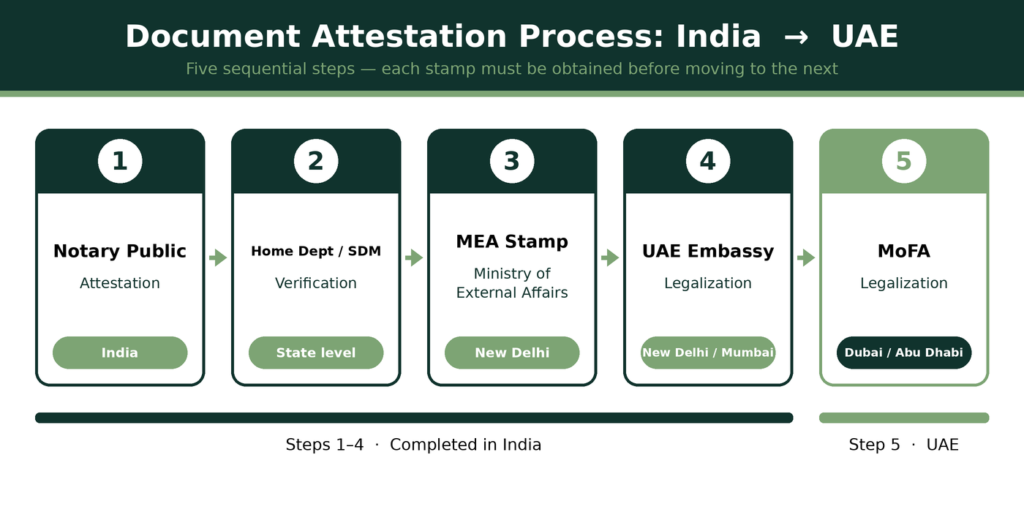
To register a Branch or Wholly Owned Subsidiary of an Indian company in the UAE, all official corporate documents issued in India must undergo legal attestation.
Required Corporate Document Package
-
Certificate of Incorporation (COI) of the Indian parent company.
-
Memorandum and Articles of Association (MOA / AOA).
-
Board Resolution authorizing UAE expansion, setup, and appointment of the Legal Representative.
-
Power of Attorney (POA) issued to the UAE setup consultant or Director.
-
Good Standing Certificate / Incumbency Certificate.
-
Audited Financial Statements of the Indian parent company (last 2 years).
Setup Costs & Investment Parameters
The cost to expand or relocate an Indian enterprise to the UAE varies depending on jurisdiction, structure, visa allocations, and physical space requirements.
| Cost Component | Foreign Branch Office (Mainland DET) | Wholly Owned Subsidiary (Free Zone) |
| Government Trade License Fee | AED 18,000 – AED 30,000 | AED 12,000 – AED 25,000 |
| Ministry of Economy Registration | AED 10,000 to AED 15,000 | N/A |
| Document Attestation (MEA + UAE) | AED 4,000 – AED 8,000 | AED 4,000 – AED 8,000 |
| Office Lease / Flexi-Desk | AED 15,000+ (Ejari lease) | AED 6,000 – AED 18,000 (Flexi-desk) |
| Immigration & Establishment Card | AED 2,500 | AED 2,000 |
| Investor / Employee Visa (per person) | AED 3,500 – AED 5,500 | AED 3,000 – AED 5,000 |
Note: Figures represent general government and administrative cost ranges. Review specific UAE business setup costs for Indian businesses for detailed itemized estimates.
Corporate Banking & Multi-Currency Remittances
Establishing a multi-currency corporate bank account in the UAE enables Indian companies to manage USD, EUR, AED, and INR cash flows efficiently.
Key Banking Requirements for Indian Expansions
-
Attested corporate documents of the Indian parent company (COI, MOA, Board Resolution).
-
Copy of the new UAE Trade License and registered Lease Agreement (Ejari).
-
Passports, Emirates IDs, and Residence Visas of the appointed Signatories and Directors.
-
6 Months of Bank Statements from the Indian parent company.
-
Existing Commercial Contracts, Supplier Invoices, and a structured Business Plan.
Planning to Expand Your Indian Enterprise to the UAE?
Navigating RBI/FEMA approvals, MEA document attestation, and UAE mainland/free zone licensing requires experienced, end-to-end guidance.
Schedule a Cross-Border Expansion Strategy Session with Kwsncompany to evaluate your corporate structure, tax liabilities, and setup timelines.
Frequently Asked Questions
Can an Indian company open a branch office in Dubai?
Yes, an Indian parent company can establish a 100% owned Foreign Branch Office in Dubai through the Department of Economy and Tourism (DET) or within select Free Zones. The branch acts as a direct extension of the parent company.
Do I need RBI approval to expand my Indian business to the UAE?
Overseas direct investments (ODI) in a UAE branch or subsidiary generally fall under the Automatic Route via an Authorized Dealer (AD Category-I Bank), provided investments remain within RBI framework limits and Form FC is filed properly.
What is the attestation process for Indian documents required in the UAE?
Corporate documents must be notarized in India, verified by the state Home Department/SDM, attested by the Ministry of External Affairs (MEA) in New Delhi, legalized by the UAE Embassy in India, and finally stamped by MoFA in the UAE.